

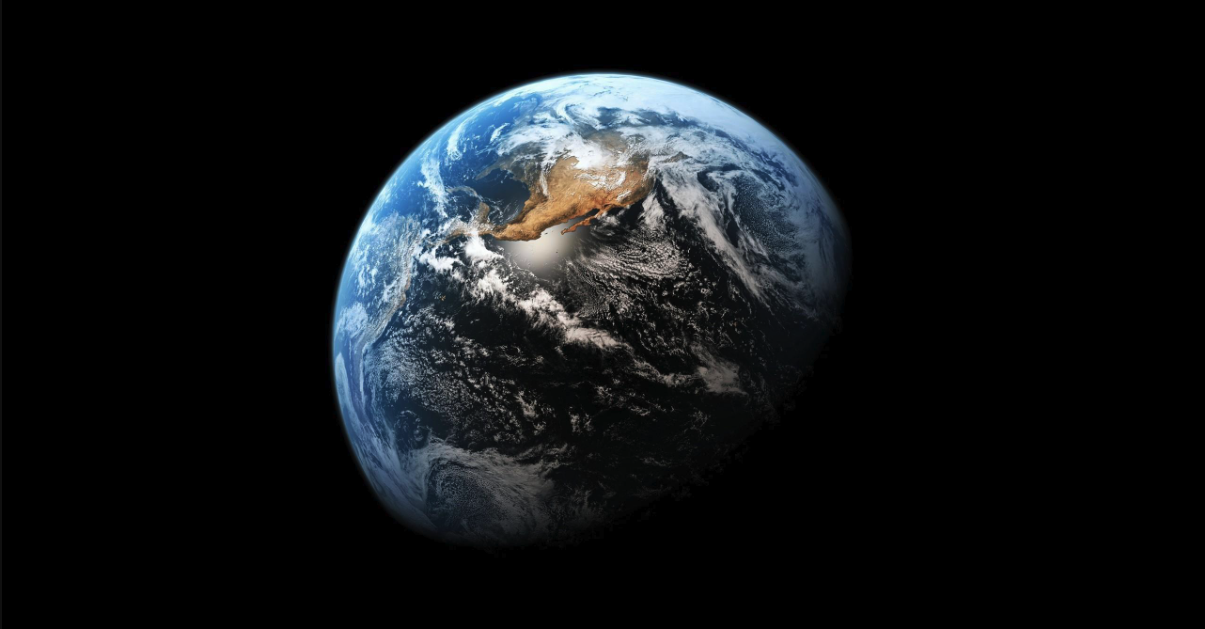
Human Induced Climate Change
Summary
The number one critical issue impacting all life on earth is human induced climate change. It is already too late to avoid severe consequences, but it may not be too late to save complex living species and perhaps even someof the more valuable aspects of modern human societies.
The Greenhouse Effect
Earth’s temperature comes from absorbed solar energy radiating from the Sun. Roughly 30 percent of incoming sunlight is reflected back into space by bright surfaces such as clouds and ice. Of the remaining 70 percent, most is absorbed by land and sea. The rest is absorbed by the atmosphere.
As the land, air, and the sea warm, they radiate “heat” energy (thermal infrared radiation). This energy travels into the atmosphere where much of it is absorbed by water vapor and long-lived greenhouse gases, such as carbon dioxide and methane.
As atmospheric gasses absorb energy radiating from Earth’s surface, they too begin radiating heat. The energy that radiates back toward Earth heats both the lower atmosphere and the surface, enhancing the heating they get from direct sunlight.
This absorption and radiation of heat by the atmosphere – the natural greenhouse effect – is essential for life on Earth and human civilization. If there were no greenhouse effect, the Earth’s average surface temperature would be about -18°C (0°F) instead of today’s average of 15°C (59°F).1
Human Induced Climate Change
Over the past 250 years, humans have been artificially raising the concentration of greenhouse gases in the atmosphere at an ever-increasing rate, mostly by burning fossil fuels, but also from cutting down carbon-absorbing forests. Today, the main drivers of these emissions are burning fossil fuels, unsustainable land use, and the unsustainably high consumption of curtain foods, such as industrially-produced beef and pork.
Since the Industrial Revolution began in about 1750, carbon dioxide levels have increased nearly 38 percent as of 2009 and methane levels have increased 148 percent.
A major cause of global warming has been the increasing release of CO2 through human activity. In the past 150 years. CO2 in the Earth’s atmosphere has increased from 280 parts per million (ppm) to 414 ppm. The consequences are dire. Massive positive feedback loops, such as melting glaciers and thawing permafrost have already begun. If humanity does not wise up now, there may be no way to slow or reverse such processes.
The Intergovernmental Panel on Climate Change (IPCC), a United Nations organization that includes 195 member countries and thousands of independent scientific experts, published a Synthesis Report in March 20232. It concluded that human activities, principally through greenhouse gas emissions, have unequivocally caused global warming. It’s worth noting that although alarming, these governmental reports are invariably conservative in their estimates, with each new report revising the findings of the previous report. As dire as the report’s conclusions are, scientific data paints an even more dire situation.
Models predict that Earth will warm between 2 and 6 degrees Celsius in the next century. When global warming has happened at various times in the past two million years, it has taken the planet about 5,000 years to warm 5 degrees. The predicted rate of warming for the next century is at least 20 times faster. This rate of change is extremely unusual. Complex living species can not evolve this fast, and many will disappear.
Footnotes
-
Source: NASA: Energy Balance, http://earthobservatory.nasa.gov/Features/EnergyBalance/ ↩︎
-
Source: AR6 Synthesis Report: Climate Change 2023, https://www.ipcc.ch/report/ar6/syr/ ↩︎
Timeline
| Key Climate Change Events | ||
|---|---|---|
|
1824
|
Joseph Fourier proposes the greenhouse effect, laying the groundwork for climate science.
|
|
|
1896
|
Svante Arrhenius constructs the first climate model of the influence of atmospheric carbon dioxide (CO2 and hypothesizes that increased CO<sub2 levels from fossil fuels will raise Earth’s temperature.
|
|
|
1920 to 1925
|
The era of large-scale petroleum development, beginning with the opening of Texas and Persian Gulf oil fields.
|
|
|
1938
|
Guy Callendar provides evidence that global temperatures have risen due to human activity, specifically CO₂ emissions.
|
|
|
1966
|
Bituminous Coal Research Inc., a coal industry research organization, published its finding that if then prevailing trends of coal consumption continued, “the temperature of the earth’s atmosphere will increase” and “vast changes in the climates of the earth will result. […] Such changes in temperature will cause melting of the polar icecaps, which, in turn, would result in the inundation of many coastal cities, including New York and London.” Despite that, the industry publicly advocated for decades thereafter that increased carbon dioxide in the atmosphere is beneficial for the planet.
|
|
|
1967
|
The first computer climate models predict that doubling CO₂ will raise global temperatures by about 2°C.
|
|
|
1975
|
The term “global warming” is coined by geoscientist Wallace Broecker.
|
|
|
1983
|
An Environmental Protection Agency (EPA) report stated that global warming was “not a theoretical problem but a threat whose effects will be felt within a few years”, with potentially “catastrophic” consequences. The Reagan regime labeled the report “alarmist”.
|
|
|
1985
|
Ice core studies confirm that rising greenhouse gas concentrations correlate with rising temperatures.
|
|
|
June 1988
|
James Hansen, NASA tells the US Congress that he is 99% certain that the observed temperature changes were not a natural variation.
|
|
|
1989
|
Decades of organized industry-funded denialism, including efforts by the Global Climate Coalition and the George C. Marshall Institute, copied the successful strategy developed by the tobacco industry to spread doubt and confusion among the public.
|
|
|
1989
|
With the fall of disintegration of the Soviet Union, the attention of U.S. conservative think tanks, which had been organized in the 1970s as an intellectual counter-movement to socialism, turned from the “red scare” to the “green scare” tactic, which they saw as a threat to corporate welfare, unregulated markets, and global capitalist expansion. They used environmental skepticism to promote denial of environmental problems such as loss of biodiversity and climate change.
|
|
|
2006
|
George Monbiot published an article highlighting similarities between the methods of groups funded by Exxon and those of the tobacco giant Philip Morris, including direct attacks on peer-reviewed science and attempts to sow public controversy and doubt. The tactic successfully shielded the tobacco industry from litigation and regulation for decades. A tobacco company memo stated, "Doubt is our product since it is the best means of competing with the ‘body of fact’ that exists in the mind of the general public. It is also the means of establishing a controversy.""
|
|
|
2007
|
Research shows polar regions are warming twice as fast as the rest of the planet.
|
|
|
2008 to 2017
|
The US Republican Party goes from debating how to combat human-caused climate change to arguing that it does not exist. In 2011, more than half of the Republicans in the House and three-quarters of Republican senators said, "the threat of global warming, as a human-made and highly threatening phenomenon, is at best an exaggeration and at worst an utter ‘hoax’""
|
|
|
2014
|
The US Republican Party remains unique among conservative parties in the Western World by denying the evidence of climate science. More than 55% of congressional Republicans were reported to be climate change deniers.
|
|
|
Dec 2014
|
An open letter from the Committee for Skeptical Inquiry called on the media to stop using the term skepticism when referring to climate change denial. It contrasted scientific skepticism – which is “foundational to the scientific method” – with denial – “the a priori rejection of ideas without objective consideration” – and the behavior of those involved in political attempts to undermine climate science. It said: “Not all individuals who call themselves climate change skeptics are deniers. But virtually all deniers have falsely branded themselves as skeptics. By perpetrating this misnomer, journalists have granted undeserved credibility to those who reject science and scientific inquiry.”
|
|
|
2015
|
The Paris Agreement is established, aiming to limit global warming to below 2°C above pre-industrial levels.
|
|
|
Feb
26
2015
|
On the floor of the U.S. Senate, Republican senator Jim Inhofe displayed a snowball as evidence the Earth was not warming The year 2015 soon proved to be the hottest year on record, but it was soon surpassed by an even hotter 2016.
|
|
|
2016
|
During election campaigns, every Republican presidential candidate questioned or denied climate change, and opposed U.S. government steps to address it.
|
|
|
2020
|
The years 2016 and 2020 are tied as the hottest years on record.
|
|
|
2024
|
The average annual temperature of the contiguous U.S. was 55.5°F, 3.5°F above average and the warmest in the 130-year record. Annual precipitation for the contiguous U.S. was 31.58 inches, 1.66 inches above average, ranking in the wettest third of the historical record (1895–2024).
|
|
Take Action
 Global
Sonoma County Climate Activist Network (SoCoCAN!)
 Local
Local
Daily Acts
 Local
Global
Local
Global
The Climate Center
 Global
Climate Action Tracker
 Global
Climate Analytics
 Global
The Climate Clock
 Global
Earth.com
Global
Jeffrey Sachs
 Global
 Global
UN Global Issues: Climate Action
 Global
UN Global Issues: Climate Change
Global
UN World Meteorological Organization
 Regional
 Global
Federation of American Scientists
Global
Sunrise Movement

Sunrise Movement, Sonoma County
Regional
Living on Shaky Ground
 Global
Purple Air
 Global